
Researcher warns prairie wild pig populations growing despite eradication claims
By Sheri Monk
Canada’s wild pig problem may be more difficult to eradicate than some organizations acknowledge. Researchers studying the invasive species say populations continue to expand across the Prairies while control efforts remain fragmented and key data – including population estimates – remain unavailable.
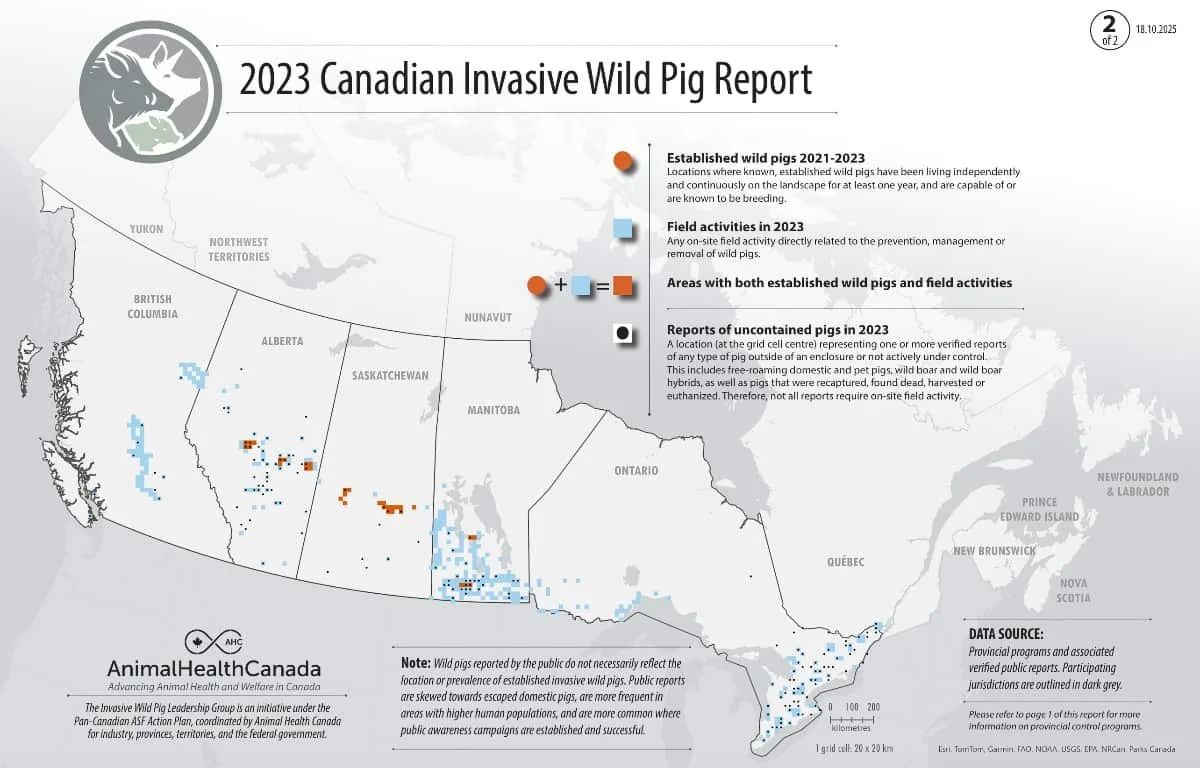
The map released by Canada’s Invasive Wild Pig Leadership Group shows in orange where wild pigs have been living for at least a year and are capable of reproducing.
The debate has intensified as organizations and provincial governments promote eradication strategies and national coordination plans – even as Canada’s leading researcher on the topic questions whether current removal rates are sufficient to slow population growth.
Dr. Ryan Brook, an associate professor at the University of Saskatchewan, leads the country’s only long-running research program on wild pigs. His team has spent more than a decade mapping the distribution of the animals across Canada using trail cameras, GPS collars, satellite tracking and public sightings. Brook has authored 19 published papers relating to wild pigs in Canada.
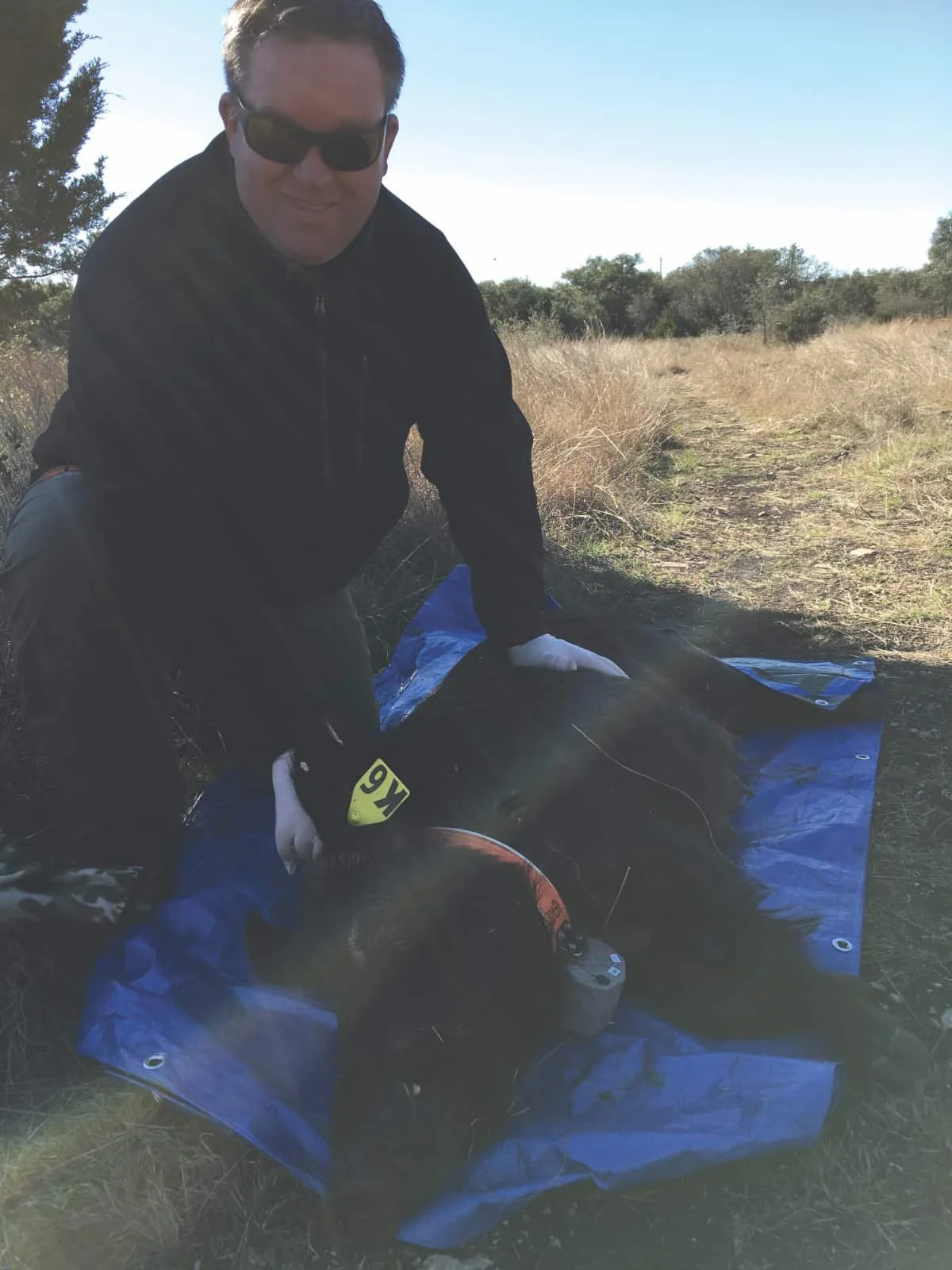
Dr. Ryan Brook has 19 published papers about wild pigs in Canada.
“We’ve published our research in peer-reviewed research journals. I think that has a lot of importance because that peer-review process helps ensure the work is credible and appropriately conducted,” Brook said.
Wild pigs – also known as wild boar or feral swine – were introduced to Canada in the 1980s and ’90s as part of a push to diversify agricultural production. When the market for wild boar meat collapsed, some animals escaped farms and others were deliberately released.
Since then, the animals have adapted well to Canadian conditions and now occupy significant areas of Saskatchewan and Manitoba, with additional populations in Alberta, B.C. and Ontario.
Provincial organizations working on the wild pig problem
British Columbia – The B.C. Feral Pig Working Group is led by the Ministry of Land and Resource Stewardship, with the participation of the Invasive Species Council of B.C. and the B.C. Wildlife Federation. Additional members include First Nations representatives, regional stakeholders, landowners and contracted trappers.
Alberta – Control efforts are led by the Alberta Government through the Wild Boar Control Program, which is administered by the Inspection and Investigation Section of Alberta Agriculture and Irrigation under the Agricultural Pests Act.
Saskatchewan – The Saskatchewan Crop Insurance Corporation (SCIC), a Crown corporation, manages their wild pig program.
Manitoba – Manitoba Pork manages Squeal on Pigs Manitoba, which was established in 2022 and receives federal and provincial funding.
Ontario – The Ministry of Natural Resources manages wild pig control for the province.
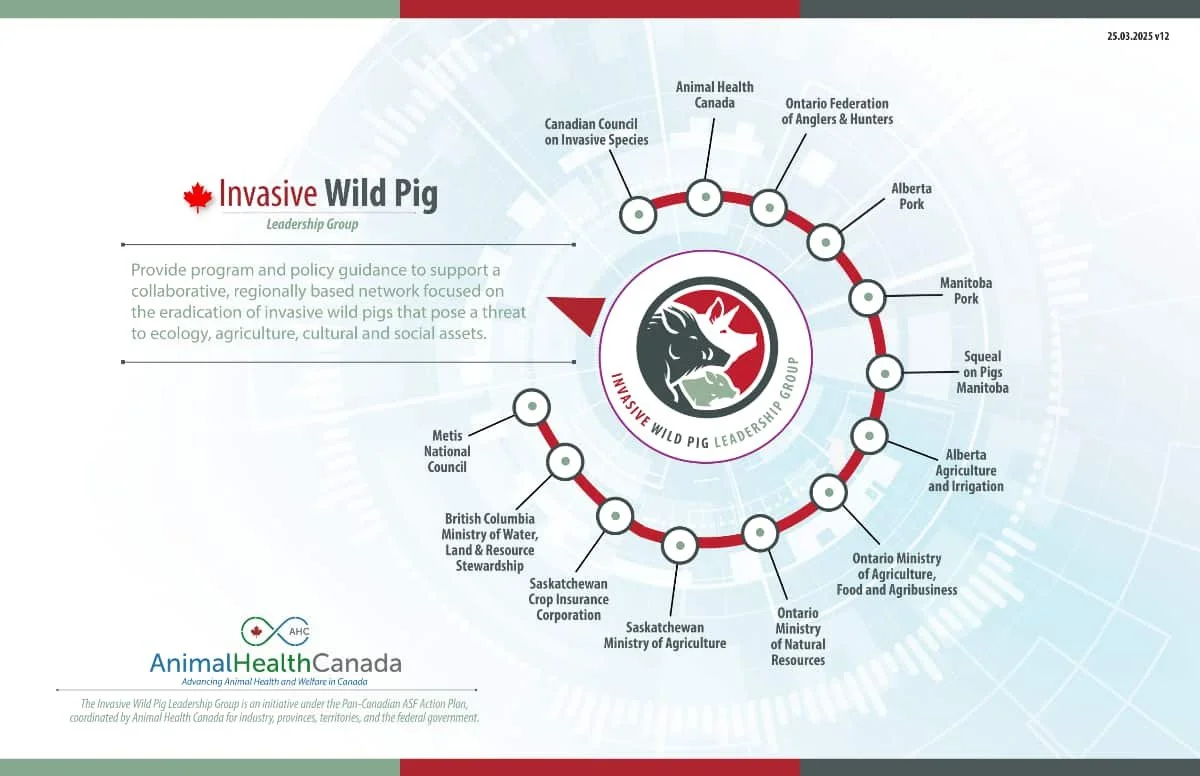
Invasive Wild Pig Leadership Group.
Nationally, a collaborative organization called Canada’s Invasive Wild Pig Leadership Group released an eradication plan called Canada’s Invasive Wild Pig Strategy 2022–2032. Its membership includes representatives from:
Alberta Ministry of Agriculture and Irrigation;
Alberta Pork;
Animal Health Canada;
British Columbia Ministry of Water, Land and Resource Stewardship;
Canadian Council on Invasive Species;
Manitoba Pork, which operates the “Squeal on Pigs” program within the province;
Métis National Council;
Ontario Federation of Anglers and Hunters;
Ontario Ministry of Natural Resources; and
The Saskatchewan Ministry of Agriculture.
Brook said he was asked to review an early draft of the national strategy but believes his feedback was largely ignored.
“I wrote a page of commentary, but I don’t think any of it was really addressed. The national strategy is very, very weak,” Brook said. “If you actually search the entire document, you will not find the word science in it anywhere.”
Alberta leading the West
When wild pigs were initially discovered in Canada, each province took an “open season” approach, allowing the animals to be hunted. This method has been proven in other jurisdictions to create more spread and increased nocturnal behaviour. It also tends to only remove either isolated solo males or individuals from larger sounders (groups) of wild pigs. It is well established that the only way to make a dent in wild pig populations is to employ techniques that capture entire sounders. Brook was publicly critical of bounties and the open season approach years ago, when the invasive problem was first identified.
Domestic wild boar farms were established during the 1980s and 1990s and they were the original source of wild pigs in Canada from escapes and purposeful releases. Some farms still exist in B.C., Alberta and Saskatchewan – under much tighter regulation – and no new farms will be permitted across the Prairies and Ontario.
Of all the provinces, Alberta is most closely following widely known best practices. As of December 1, 2025, significant changes were made to regulations that more closely follow known science.
The hunting of wild pigs is no longer permitted except on privately owned land;
All wild boar and their hybrids are now classified as a pest, not just when roaming free;
No new wild boar farms are allowed and it is now illegal to keep, import, sell or transport live wild boar without a permit;
Compensation of $590 per boar for producers who wish to exit the industry, as well as available compensation for fencing that will no longer be needed;
Existing farms must operate under strict conditions, including containment standards, mandatory escape reporting, and they must comply with annual site inspections.
Brook said Alberta has historically taken more proactive steps and been much more collaborative than its neighbour to the east.
“Alberta has consistently had the smaller distribution and clearly a lower number of pigs,” he said. “They’ve been proactive in trying different things for a long time.”
New boar farms for meat or for sport hunting are prohibited from operation in Alberta, Saskatchewan, Manitoba and Ontario.
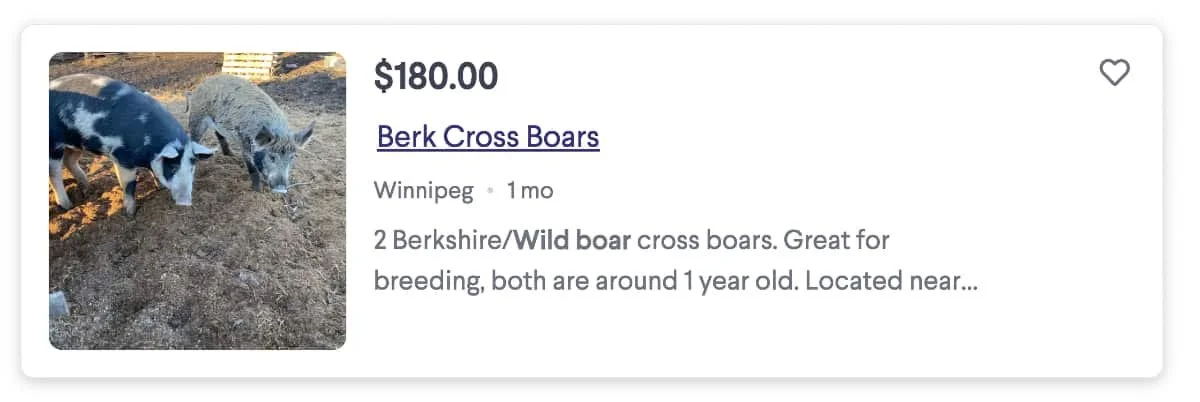
B.C. still has a handful of wild boar meat farms in operation, but there are no existing hunt farms. Saskatchewan has grandfathered hunt and meat farms, and there is no compensation in place for industry exit, though existing operations are subject to tight controls. Manitoba allegedly no longer has any wild boar farms, but wild-cross boars are still being sold on Kijiji, according to an ad that was active on March 9 of this year. Ontario has effectively eliminated them through the use of compensation for industry exit programs.
Ontario banned wild pig hunting in 2022 for the same reasons Alberta did in 2025 – it scatters the animals, ultimately making them more difficult to manage. The wild pigs can also become increasingly nocturnal under human hunting pressure, which can also make management more challenging. B.C., Saskatchewan and Manitoba still allow wild pigs to be hunted.
All provinces have ways the public can report wild pig sightings, with potential follow-up, monitoring and trapping.
Population estimates remain unclear
Provincial wild pig control programs often cite the number of animals removed through trapping programs as evidence of progress. In 2024, 206 pigs were trapped in Manitoba through the Squeal on Pigs program, which is led by project coordinator Dr. Wayne Lees.
“That’s a good thing,” Brook said. “That’s certainly a lot better than what it used to be.”
But Brook says those numbers alone provide little insight without knowing the total population size.
“We know the numerator, but what’s the denominator?” he said. “You have 200 per year removed. Well, out of how many? If it’s 200 out of 205, then that’s wonderful. But it’s not 205. That number is much higher. It’s certainly in the thousands.”
Lees says estimating wild pig populations is difficult because the animals are unevenly distributed across the landscape. In email correspondence, Lees described Manitoba’s population as being in the “low thousands,” later clarifying that he meant closer to “one thousand-ish.”
Even if populations were as low as 1,000 animals, removing around 200 per year would represent only a small portion of the population.
“Even 200 out of 1,000 is just 20 per cent,” Brook said. “And 20 per cent is nowhere near anything close to reducing the population, much less eradicating it. I think there are two key questions – is eradication feasible and when/if eradication occurs, how do you prove it? I expect at bare minimum, you would need five years of intensive monitoring with no pigs detected at all before anyone could say eradication was successful.”
Disagreement over reproduction and winter survival
Lees says winter mortality among piglets may play an important role in limiting population growth but admits there is no data to support this theory. Wild boar are endemic to Eurasia and, in the northern regions, which are climatically similar to Canada, the young have a 50 per cent survival rate in average winters.
Brook says there is no evidence supporting that claim.
“There’s no evidence that they do poorly overwintering in Canada,” he said. “We have very clear trail camera photos of groups of pigs with females with multiple litters that are months apart. A single female with multiple litters — that’s about as clear as you’re going to get.”
Brook’s research team has published studies documenting reproductive rates.
“We published papers on reproductive rates and we know they have six young per litter,” Brook said. “We see females with lots of young at heel in our trail camera photos.”
Peer-reviewed research shows the same reproductive rates in Eurasian wild boar populations, with females commonly producing litters of five to seven piglets, with survival rates high enough to support rapid population expansion.
“Anybody that’s talking without data is just another person with an opinion,” he said.
The Squeal on Pigs (Manitoba’s) own home page, for which Lees is project coordinator, reads that “(wild pigs) reproduce alarmingly fast, with females giving birth to four to 12 piglets up to twice a year.”
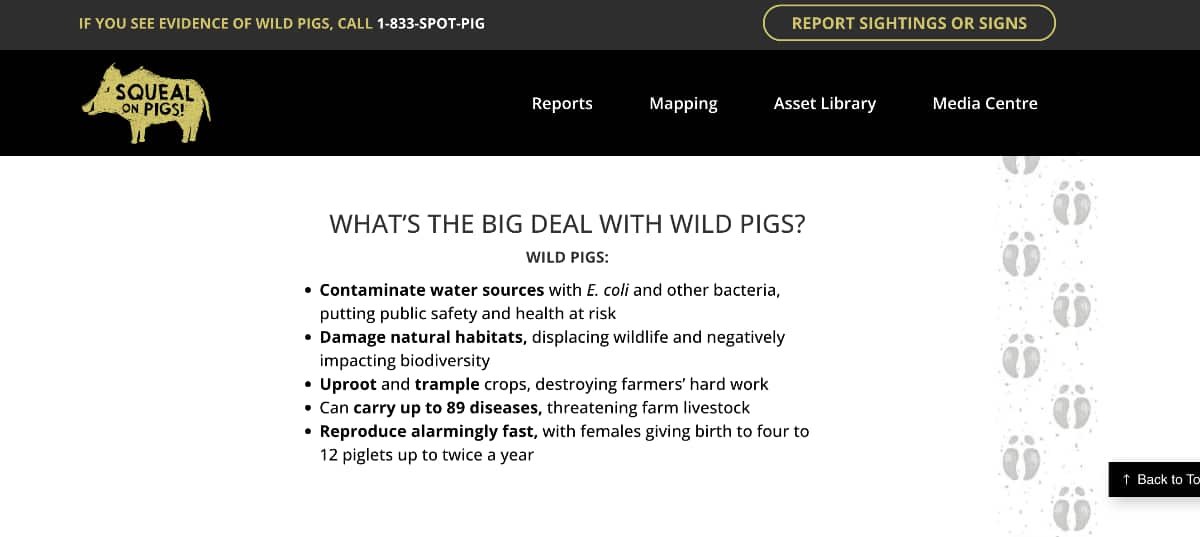
Squeal on Pigs.
Data gaps and mapping differences
When asked for details about wild pig management in Saskatchewan — including population estimates, mapping data and removal numbers for 2025 — Saskatchewan Crop Insurance Corporation (SCIC) declined to answer specific questions and would not consent to an interview.
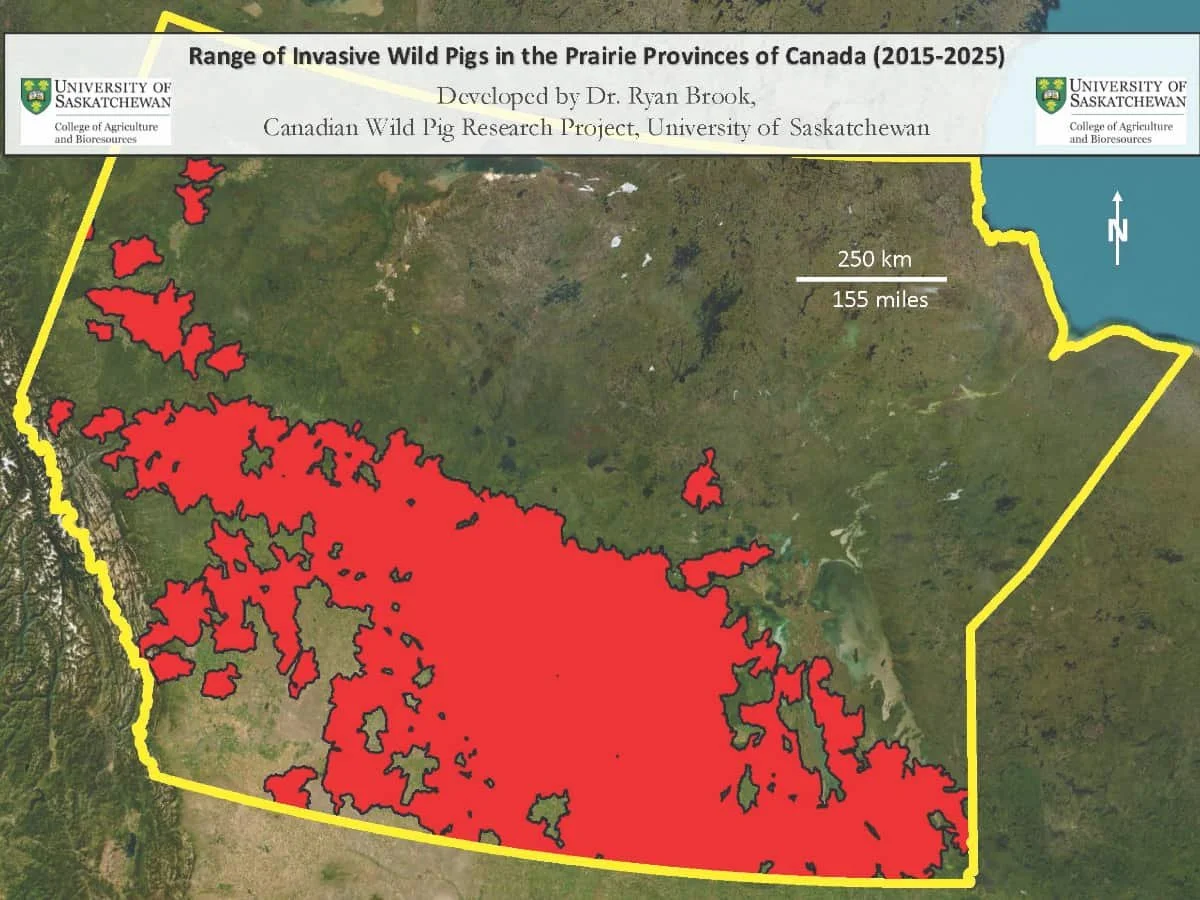
Dr. Ryan Brook’s map of wild pig activity across the Canadian Prairies since he began studying them 16 years ago.
Instead, the agency provided a general briefing note stating that more than 1,300 pigs have been removed from the province since 2017 — an average of 144 per year.
“Saskatchewan’s feral wild boar population remains limited, with animals primarily concentrated in two small regions of the province,” the briefing stated.
Brook maintains there are thousands of animals based on his research.
The SCIC document did not include population estimates or detailed mapping data, which was requested. Additionally, the corporation was asked how the wild pigs’ effect on wildlife and habitat is being monitored and that question wasn’t answered either.
Brook says the absence of transparent data makes it difficult to assess whether control programs are working.
As part of their 2023 report, Canada’s Invasive Wild Pig Leadership Group released a map illustrating its take on boar sightings and activity. Each grid cell (square) on the map represents a 20-by-20 square kilometre area. It does not take into account Brook’s data over the years. Brook’s mapping utilizes cumulative pig presence over time, including presence in watersheds. Using watersheds for mapping presence is common in wild pig research, but Lees says it’s not practical, and they want to know where the pigs are now, not where they’ve been.
“I’ve seen some of his maps and what ends up happening is that he layers the different sightings across the province and he never takes anything off, so you keep adding more and more and more layers,” said Lees. “What we wanted to do was look at the data to say, ‘where are the pigs now?’ not ‘where were they 10 years ago?’ And so this is the most up-to-date information that we have in terms of where the pigs are now and where they’re concentrated.”
Brook maintains if pigs were present in an area in the past, they are likely still present in that area currently.
Hunting controversy
Hunting wild pigs has gained popularity since the animals became invasive, and not every hunter wants to give the hunting opportunity up. However, wild pigs are known to cause extensive environmental harm and can be especially hard on waterfowl. Additionally, they displace wildlife and cause habitat degradation through rooting, wallowing and trampling behaviour. Sensitive grassland species may be especially affected, particularly during nesting season. Ducks Unlimited was asked to offer their position on the issue and didn’t return phone calls or emails.
While Alberta and Ontario have banned wild pig hunting, B.C., Saskatchewan and Manitoba have failed to do so thus far.
“We don’t encourage it. It has not been banned, but one thing we find is it’s not effective and it tends to displace pigs. If there is a group of pigs in one area and then hunters try to bait that area and hunt pigs, they can move them out into a new area,” said Lees. “The other issue is that when wild pigs move into an area, things like turkeys and deer tend to move away. So it’s a choice – what do you want to hunt?”
The Saskatchewan Wildlife Federation – largely funded by the hunting community through fundraising, membership, donations and through allocated funds from the Saskatchewan Fish and Wildlife Fund – doesn’t currently have a position on pig hunting but said they are adding the issue to its next board meeting.
A growing risk
Wild pigs present more than an ecological threat. The animals can carry diseases such as African swine fever, which has devastated pork industries in parts of Europe and Asia.
Brook says the presence of wild pigs could make controlling such a disease far more difficult if it ever reached Canada.
“These wild pigs are a threat with respect to African swine fever,” he said.
Lees agrees.
“If we were to get African swine fever in wild pigs, it would be very, very difficult to manage,” he said.
African swine fever is incredibly contagious, almost always fatal to pigs, and would instantly devastate the Canadian pork industry due to lost export markets. If such an outbreak were to occur, industry would work with the Canadian Food Inspection Agency (CFIA) to establish movement corridors, quarantines and mass euthanasia in affected areas. A wild pig population could act not only as a disease reservoir but could diminish confidence in export markets and pork industry investors.
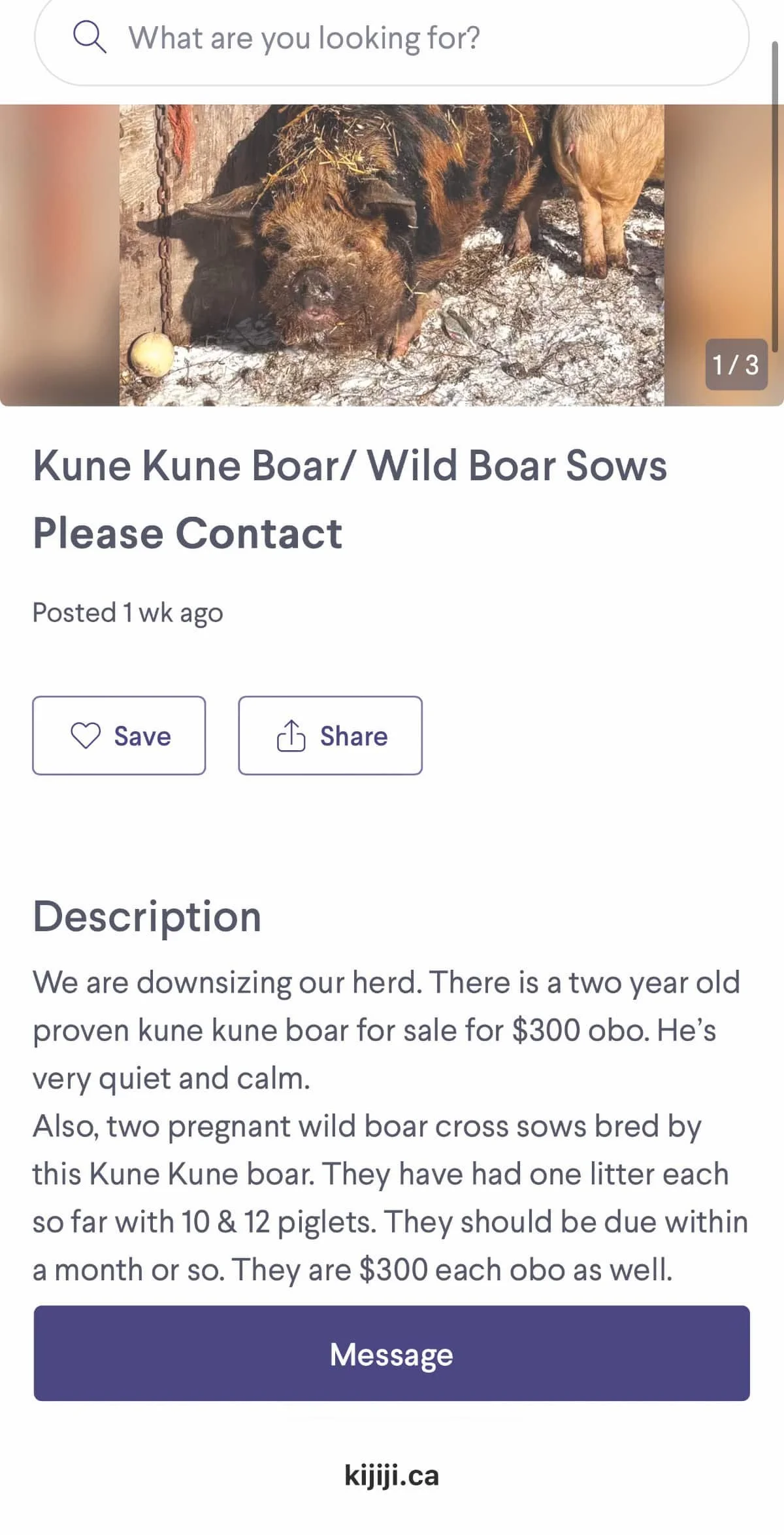
A quick Internet search shows many outdoor domestic pigs for sale across the Prairies, including an ad out of Moosomin, Saskatchewan, for two pregnant wild boar sow mixes. Keeping captive pigs in outdoor spaces when wild pigs may be just on the other side of the fence is a health threat. While Saskatchewan hasn’t made existing wild boar farms illegal, Manitoba has and despite that, there was an active Kijiji ad for wild boar as of March 9, 2026. Brook said this method of sales has been widely utilized for wild pig transactions and has published a paper on the issue.
Click for larger images
The swine industry in Saskatchewan contributes $558 million (one per cent) to the provincial GDP. In Manitoba, the industry is even larger, making up $2.3 billion (3.5 per cent) of the province’s GDP. In Alberta, the swine industry contributes $1.6 billion to the provincial GDP, but this represents less than a half per cent of total GDP.
A narrowing window
When asked about timelines for eradication, Lees said he has never attached a specific timeframe to the goal. However, in 2024 he was quoted in the Western Producer as saying, “It’ll probably take most of a decade.”
When asked by email whether he still believed that was achievable, Lees never answered.
Brook says Canada still has an opportunity to control wild pig populations before they reach the scale seen in the United States, where millions of animals now roam across large parts of the country. But that opportunity may be shrinking without substantive efforts, benchmarks and monitoring.
“Anyone talking about the eradication of wild pigs from the Canadian prairies in 2026 fundamentally misunderstands the scope and scale of the wild pig problem and is living in a fantasy world of their own creation,” Brook said. “The fraction of pigs actually being removed is small – somewhere in the order of 10 per cent at best. There is a very large gap between 10 per cent and what we know is more than 70 per cent removal to see population reductions.”
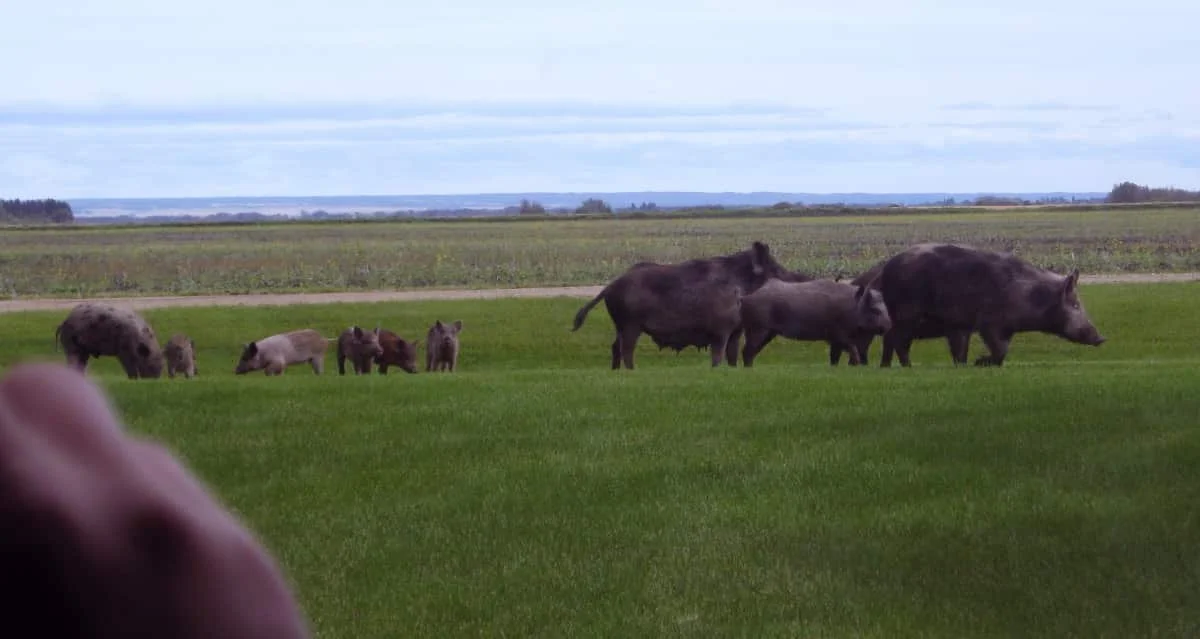
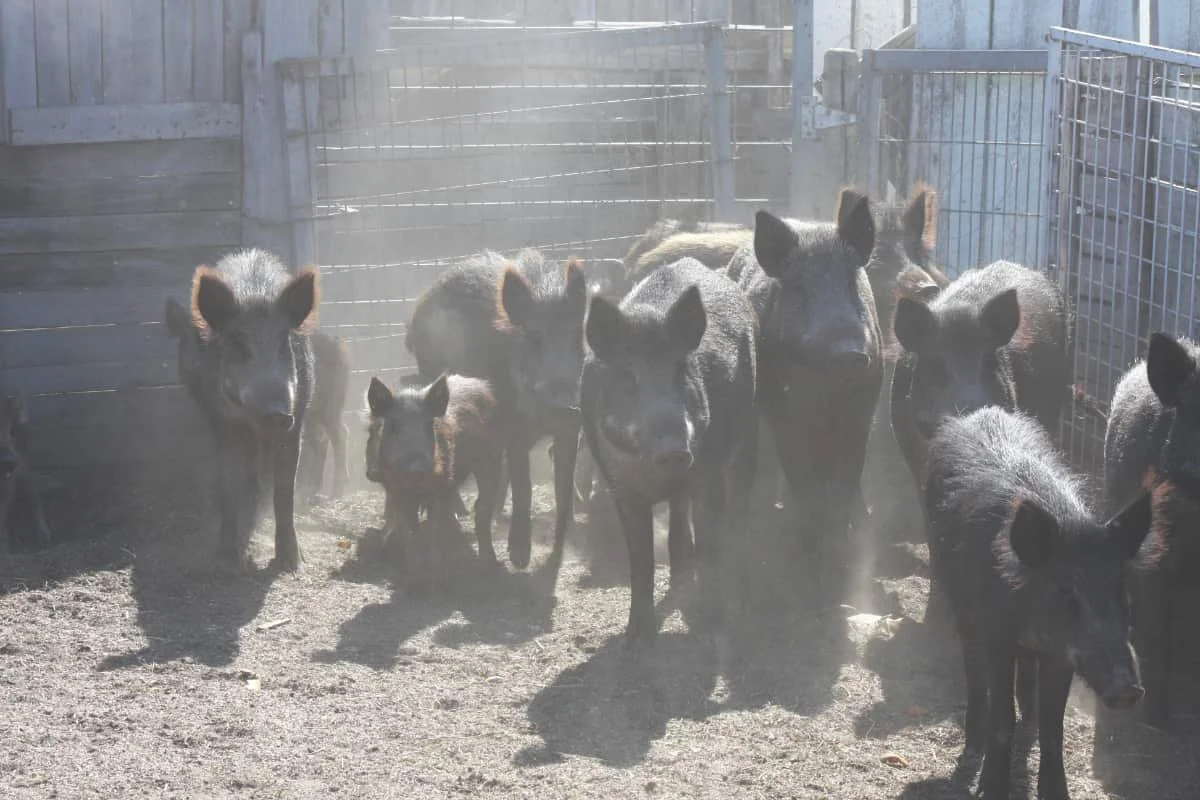
This photo shows what Dr. Brook refers to as a “super pig” – wild boar crossed with a domestic pig. In this photo, we see sows with young of different ages.
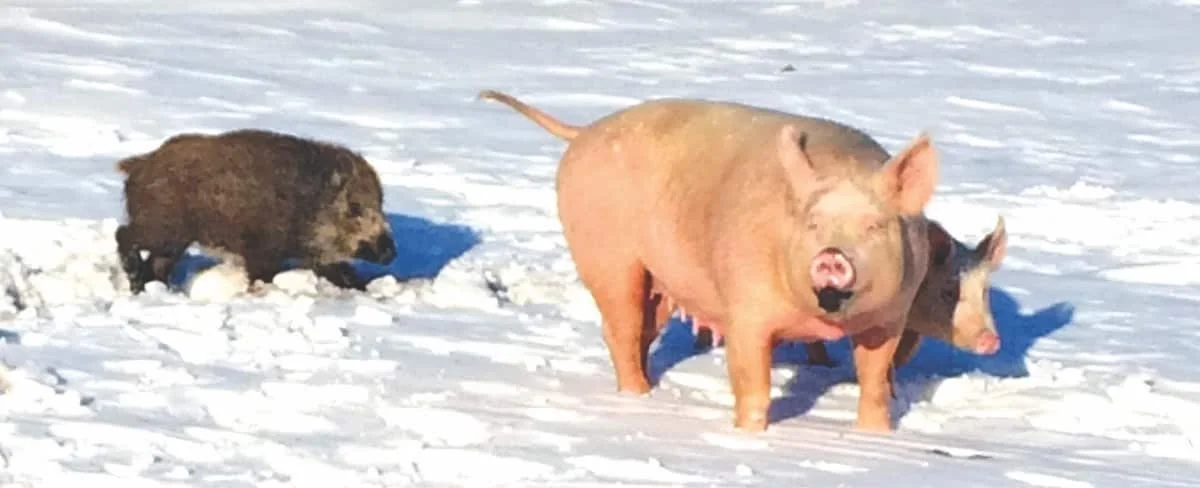
Direct and indirect contact between invasive wild pigs and domestic pigs are high risk for disease transmission.