
Canada’s beef herd responding to expansion signals
By Sheri Monk
The numbers are in and it’s official – Canada’s beef herd is growing for the first time since 2018. “The market has been extremely strong, and rightfully so. There's some profit potential behind those numbers, and you can't make cows without cows,” said Canadian Cattle Association (CCA) chair Tyler Fulton.
According to Statistics Canada, the national beef herd is up 2.5 per cent to 11.14 million head of cattle. While that may not seem newsworthy on the surface, it’s the first sign of growth in eight years – despite record prices across the industry. What makes it even more remarkable is the uncertainty the industry faced just one year ago. The United States president was threatening unprecedented tariffs and talking about the annexation of Canada. Global unease across every market dominated headlines and quarterly expectations.
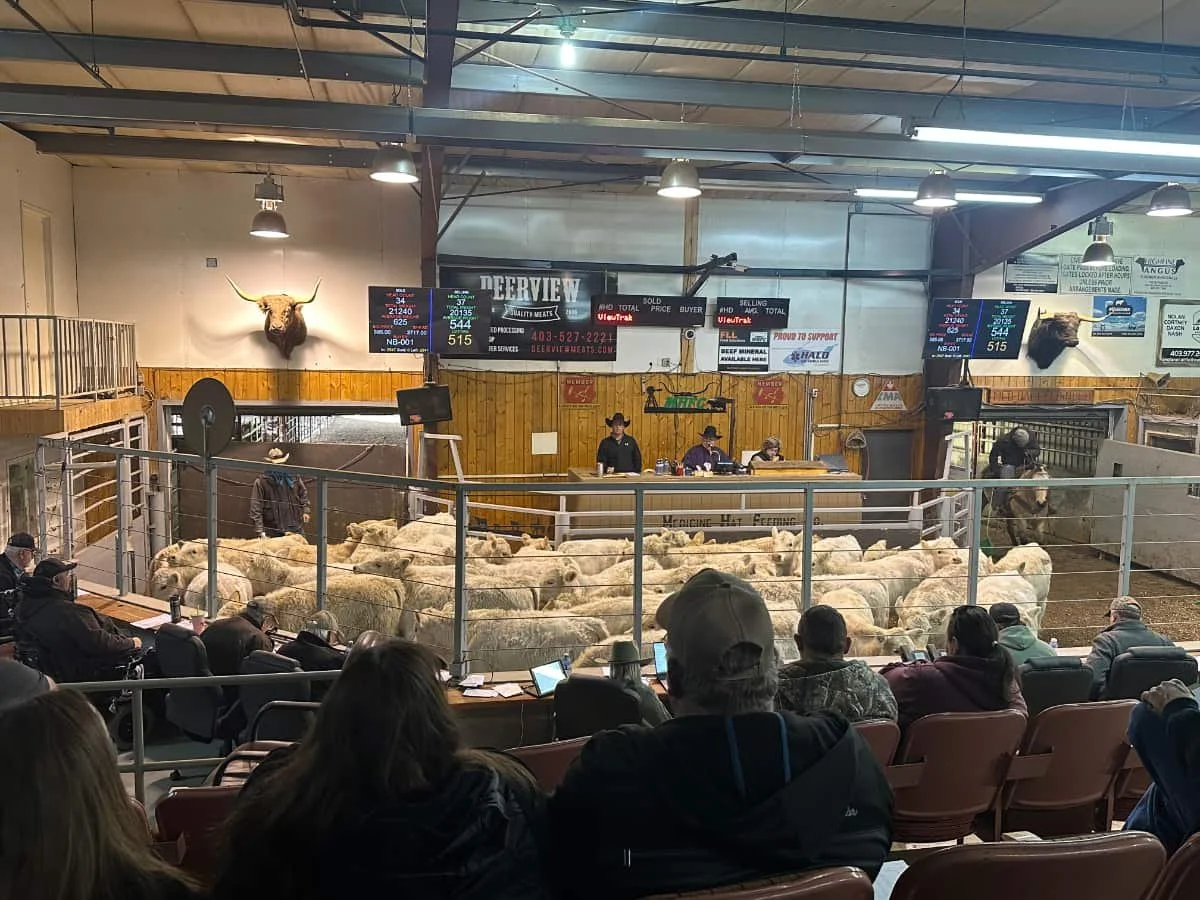
Calves are auctioned at Medicine Hat Feeding Company on October 31, 2024.
“Nationally we're up 1.9 per cent on cows, up 4.8 per cent on heifers, but really it is the farthest west that is leading the way with British Columbia up four per cent, Alberta up 2.2 per cent, and Saskatchewan up 1.5 per cent,” said Brenna Grant, executive director of Canfax.
Auction markets and processing plants were already providing anecdotal evidence of retained heifers and cows, and the numbers support the suspicions.
“On the replacement heifer side, BC replacement heifers are up 5.8 per cent, Alberta is up 5.1 per cent, and Saskatchewan is up four per cent. And so we're definitely seeing some of those differences due to weather and grass availability as well as winter feed availability in terms of who is able to rebuild and restock,” Grant said.
In 2018, the national herd contained 12.4 million head.
“And remember, this is drought-induced liquidation, so a lot of this for a lot of guys is restocking as is appropriate to their grass availability,” said Grant.
Will prices remain high?
For herd expansion to realize continued growth, the cow-calf sector will need to continue to see strong pricing.
“This is one question where we have to really think of these numbers in context. The beef cows were up just under 65,000 head. We imported 544,000 head in 2025 – we have a long ways to go on our rebuilding simply to fill domestic feedlot demand for feeder cattle that they are currently feeding and being supplied by the U.S.,” Grant explained.
As long as the fall run keeps bringing home the bacon, expansion should continue.
“We are still that highest price market in North America – that's why we're importing. So the price signal is there for these cow-calf producers to rebuild, and really the first thing that's going to happen is displacement of those imports,” said Grant.
Another bullish market development indicative of expansion is that slaughter was down in 2025, representing the holdback of heifers and to a lesser extent, cows that may have been sent to town in other years.
“We have a very different outlook for 2026. In fact, the numbers are large enough that we have the potential of larger domestic production in 2026 versus 2025 as our herd is rebuilding. It's really just unique, this cattle cycle where this is happening,” Grant said.
In 2002, the year before BSE crippled and forever changed the Canadian cattle industry, the herd was at 15.3 million head. Whether the industry rebuilds to pre-BSE numbers remains, but experts think it unlikely.
Why did it take so long?
“You can't raise cows without pasture and feed. When you get several years of the last five where, you know, the weather conditions just simply have not been conducive to, like, supporting growth in the herd, you know, it's a major factor. It's probably the most important factor that's kind of put a, you know, moderated any potential for growth. But you layer on that, the demographics of the industry, and, you know, the capital requirements, and the, you know, for new producers to enter the business, as well as the uncertainty, you know, that goes along with making those investments, it's, you know, it's a complex kind of system that, you know, that we have to, you know, that's going to feed into whether or not there's herd growth. And, you know, all of them have an influence.
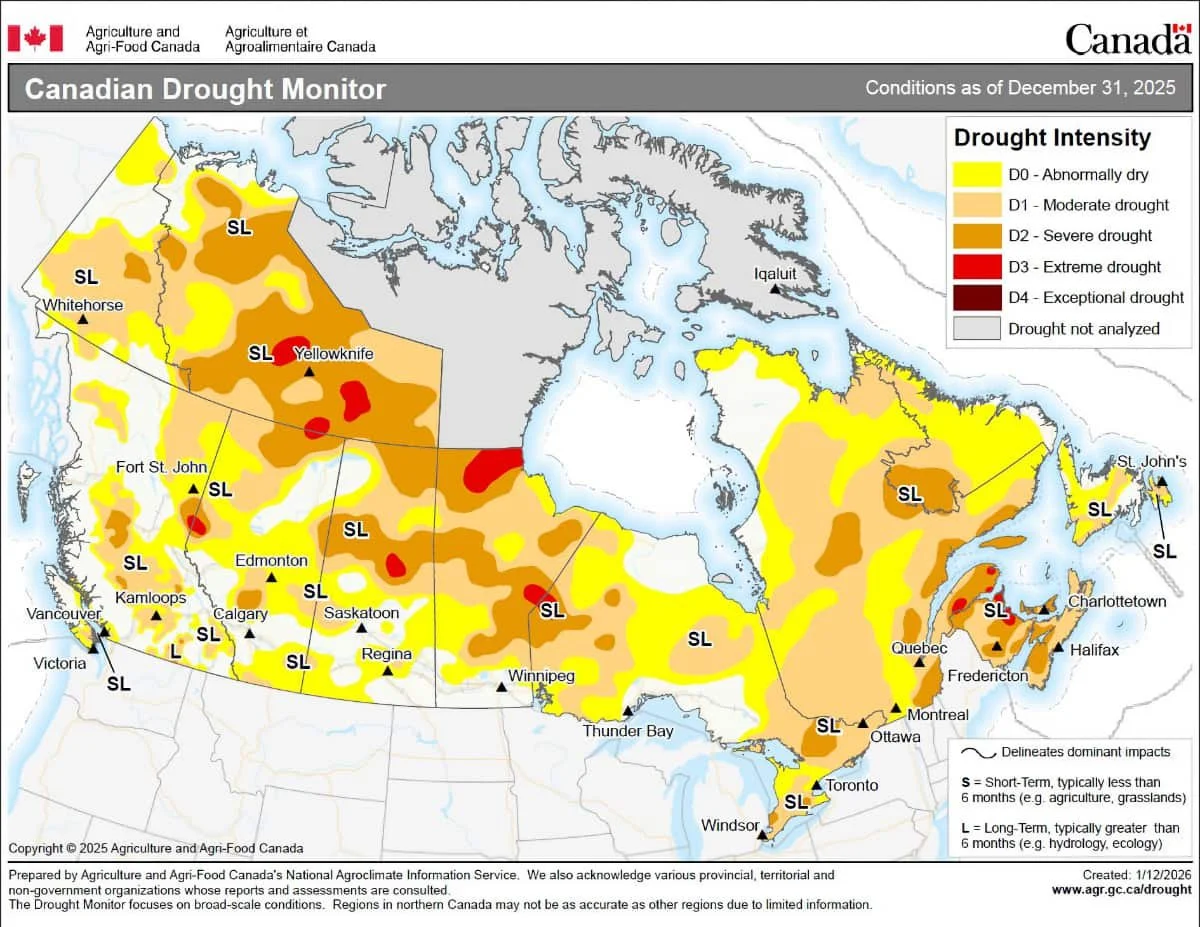
A national map of drought conditions reveals agriculture isn’t out of the woods yet when it comes to moisture.
“Everybody talks about the weather, but nobody does anything about it.’
Mark Twain may have come up with that iconic quote in 1897, but not much has changed since he did – weather remains the wildest card in the cattle business.
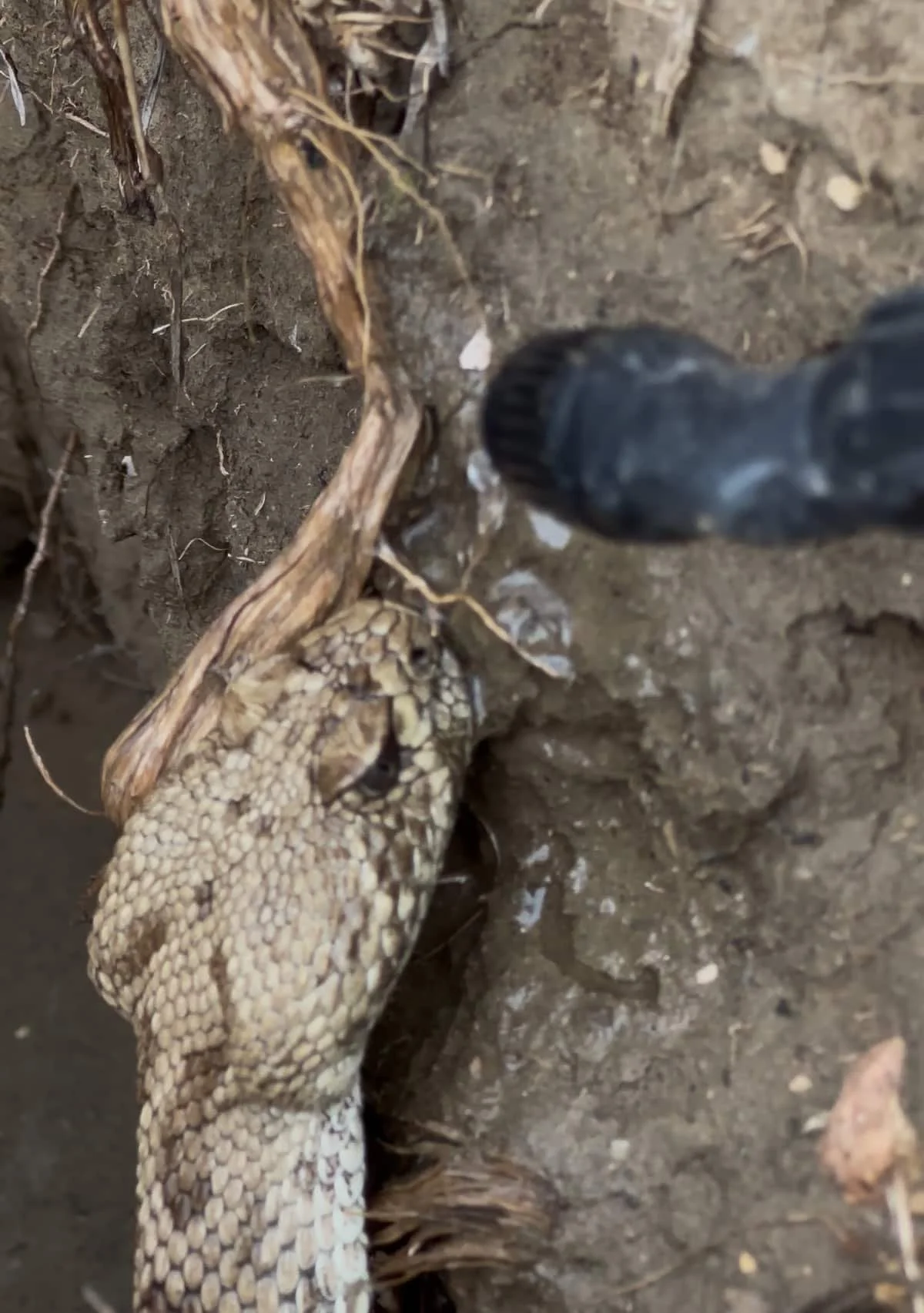
A prairie rattlesnake in southeastern Alberta gratefully accepts a drink during dry conditions last year.
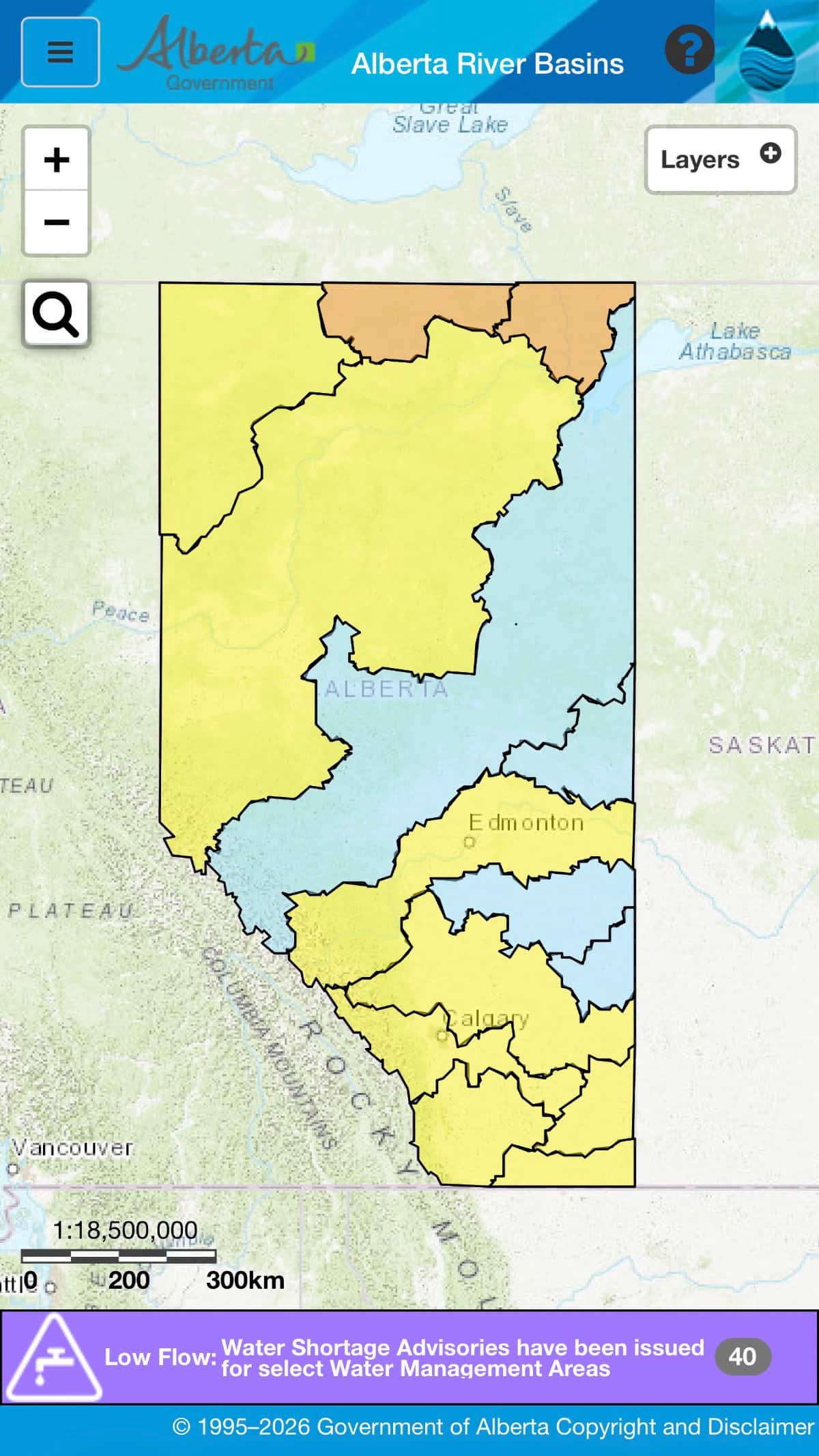
A Government of Alberta map shows much of the province is still in drought. Blue represents stage one – abnormally dry conditions, yellow represents stage two – moderate drought and orange represents stage three – severe drought.
“The moisture situation in some key spots such as southwestern Saskatchewan and southern Alberta were much improved in the fall. So maybe there's some subsoil moisture there this year that wasn't there in the past,” Fulton said. “I'd say by and large, we're better off than we've been in recent years, but there are still some constraints. I think there's a lot of optimism there. But we also have to be mindful of, you know, of the broader macro weather patterns.”
U.S. numbers continue to contract
Gold may have been just out of reach in Olympic hockey this year, but Canada is currently at the top of the podium when it comes to industry growth.
“It’s a little bit of a competition. They showed a slight further reduction and that, I think, surprised some analysts. They were anticipating a slight increase,” Fulton said.
“The U.S. beef cow herd was down one per cent on Jan. 1 and their heifer numbers were up, but it was very modest. Beef replacement heifers were up .9 per cent,” Grant said.
Weather and drought in some areas were contributing factors as many American producers simply didn’t have enough confidence they’d have access to enough winter wheat pasture or forage supplies to keep their animals fed. But weather and feed weren’t the only factors.
“When a lot of producers in the fall were making their replacement decisions in the U.S., there was so much going on politically in terms of new announcements being made almost every week in October and November and that probably had an impact,” Grant explained.
With increasing global instability, particularly in the Middle East, oil prices are increasing and in the past, the price-per-barrel used to have real implications for the beef business.
“We used to call ourselves a petro currency. When oil went up, the Canadian dollar went up, so they were very closely linked. That has not been the case in the last five years. We've actually seen our Canadian dollar move independently of petro prices,” Grant said, attributing the change to inflation and other economic changes. “I think the real question – and it would actually be the banks that usually provide forecasts and comments on this – are we going to see the Canadian dollar get more heavily linked back to crude oil prices?”
A crack in the Great Wall
In 2021, the cattle industry suffered a difficult blow from the Chinese government, which banned Canadian beef after an 8.5 year-old Albertan cow tested positive for atypical BSE. Atypical BSE occurs sporadically and isn’t related to BSE spread through contaminated feed or other exposures. China has a history of making knee-jerk trade decisions in reaction to unrelated political differences. “Those cases are always going to be found when you have a robust surveillance system,” said Fulton.
In January, Prime Minister Mark Carney and a high-profile entourage visited Beijing and it was announced shortly after that China would once again open its borders to Canadian beef.
“This is something that we're really, really happy to see,” Fulton said, adding that the CCA and many other organizations were working hard over the previous five years to re-open trade. “I'm really optimistic about it making a big difference. Where we see the value is in some of those cuts that just aren't in demand in North America or Canada. There's potential for us to add value to the carcass on those cuts that without Chinese market access, we really couldn't realize.”
China requires any imported beef to be free of beta-agonists, which tend to residually accumulate in organ tissues, which are the cuts China tends to import.
Beta-agonists redirect nutrients in cattle toward muscle growth instead of fat deposition, increasing lean meat production and feed efficiency, and are used routinely in both American and Canadian feedlots.
Grant says that while it takes time for industry to complete the paperwork needed to be considered beta-agonist-free, the effect of resuming trade is already being felt.
“We have seen our five-weight steers and heifers pop here since the announcement. We are up. And part of that on the lightweights is it takes time for them to figure everything out in terms of logistics and sales and whatnot. But right now it looks like that is absolutely a positive for our industry that is being price supportive to the feeder market,” she said.
Talkin’ traceability blues
Soaring prices, tariff talk and rising imports weren’t the only dramas taking place in the beef business this past year. The Canadian Food Inspection Agency (CFIA) plan to publish additional traceability regulations caused a viral social media tidal wave of pushback among producers.
“When that became such a big issue among producers it became obvious that we had to request a pause from CFIA about any new regulations. Because quite simply, there was not a great understanding of the information and for that matter, clarity on what the rules were,” Fulton said, adding that it is important the industry has a tool to manage animal disease risk and to regain lost market access. “Consistently, what I’ve heard from across the country is a desire for an industry solution that is not burdensome, that is not onerous on producers, and actually materially delivers a tool to address those animal disease events that represent an existential risk to our industry.”
Enhanced feed ban may be on the way out
In the wake of the 2003 BSE crisis, the CFIA introduced the enhanced feed ban in 2007 to help reopen trade – which it certainly did. The new regulations required packing plants to remove and dispose of the skull, brain, trigeminal ganglia, eyes, tonsils and dorsal root ganglia in all cattle aged 30 months and older (OTM). These tissues accumulate the densest BSE prion concentrations, but SRM removal is costly – and so is the disposal of those tissues.
“And that's something we've lived with for a long time and the challenges it creates for small and medium and also even the larger plants. I think that if that is removed and we're on an even footing with the U.S., that we could actually see greater revitalization in the small and medium plants,” Grant said.
The additional cost burden, felt first by packing plants, trickled down throughout the entire industry, but the mandate did achieve its goal. The World Organization for Animal Health responded by downgrading Canada’s BSE risk level to “controlled” and in 2021, Canada’s risk status was changed to “negligible” – the same status applied to the U.S. and EU.
Since that status change, there has been mounting pressure on the CFIA to rescind the enhanced feed ban, although the distal ileum would continue to be removed from all cattle, as it is in the U.S. and EU.
“Candidly, we've made slow progress, but progress nonetheless. And, in fact, I think we're talking about addressing it in a timeline measured in months, not in years. So I am more optimistic about that file and addressing those challenges than I was even a year ago,” Fulton said, adding that CCA staff has worked hard to equip the CFIA with thorough risk analyses over the past couple of years. “It's sometimes really difficult and time-consuming to get rid of regulations. But I'm hoping that this is an example of a real-life outcome of the government's desire to do red tape removal.”
2026 is giving optimism and excitement
In a post-Covid era when steep inflation became the norm, cattle feeders have experienced a small measure of relief amid very tight supply.
“We've seen feed grain down anywhere from 12 per cent to 18 per cent year-over-year depending on the feed type used,” Grant said.
Two years ago, while still in the early days of Russia’s invasion of Ukraine, the world braced for grain shortages and production disruptions. Ukraine is home to approximately 15 per cent of global corn exports and 15 to 20 per cent of global barley exports.
“But the reality is there was a huge increase in crop acres globally and then there were agreements made to actually continue to get grain out of Ukraine. And so, we had then this increase that's happened globally in terms of production with the expectation that that grain wouldn't be available – but it is available,” Grant said. “There are obviously price signals for adjustments to occur here in 2026. But in the meantime, it's a lot of the livestock industry that is sourcing feed and the benefits from those lower prices.”
“It's just so telling to me that we're importing the highest number of U.S. feeder cattle that we ever have before – 2025 represented the largest year of net feeder imports that we've ever seen in Canada. And so to do that in the context of this environment shows how tight the supply is, but also how competitive our Canadian feeding sector is,” Fulton said.
Grant says we haven’t had a cattle cycle like this for about 30 years, relating current conditions to those in the mid-90s that led to record cattle numbers in Canada.
“In the 1990s, we had a weak dollar and strong cattle prices. We had just had a Canadian-U.S. free trade agreement signed in ‘89, then NAFTA in 1994. We actually saw the Canadian herd expand throughout the ‘90s. We were obviously a price taker with a stronger U.S. market that allowed us to really gain market share. And I would say we actually have an opportunity right now based on competitiveness of our producers – specifically our feedlots – to have that price signal that we currently have for the cow-calf (sector) in order to gain a greater market share of the North American cattle market.”
“I'm really excited and enthusiastic about that. But I want to relay the fact that we are very much singularly focused on, you know, on making sure that we maintain that tariff-free, reciprocal North American trade in beef and cattle,” Fulton said. “When we export close to half of what we produce in Canada, we can't take our eye off the ball. That's what we need to support and maintain in order to ensure profitability and health for the whole industry.”