
Rural healthcare project earns CFSEA Community Impact Award
By Your Southwest Media Group
CONSORT, AB — The Community Foundation of Southeastern Alberta has awarded one of its two 2026 Community Impact Awards to the Consort & District Medical Centre Society for a regional project aimed at training healthcare workers from within rural communities rather than recruiting them in.
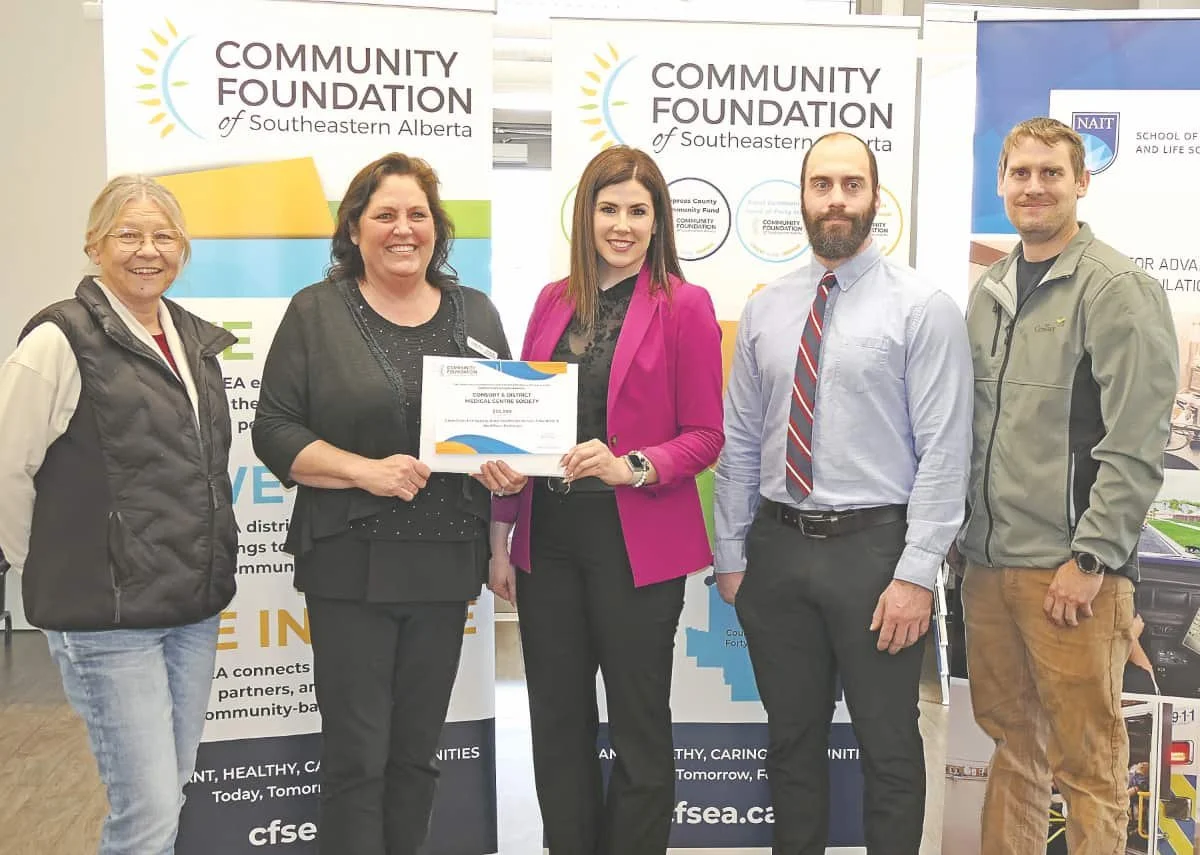
Pictured (L to R): Sandy Walters - Deputy Mayor and Medical Centre Board Member; Helene Nicholson - Regional Development Coordinator Community Foundation of Southeastern Alberta; Amy Deagle - Rural Healthcare Consultant; Dr. Efrem Violato - Applied Research Chair in Simulation and Health at NAIT; Michael Beier – Mayor and Chair of Consort & District Medical Centre Society. SUBMITTED
The cheque was presented April 22 at the Gem Centre in Consort. The project, called From Crisis to Capacity: Rural Healthcare Access, Education, & Workforce Pathways, covers Consort, Oyen, Hanna and surrounding communities in the Prairie Crocus region of Special Areas.
The award is one of two CFSEA is granting in 2026 and follows priorities flagged in the foundation's 2025 Rural Futures report, which named healthcare access among the most urgent challenges facing rural communities.
"Access to healthcare is foundational to the wellbeing and long-term resilience of rural communities," said CFSEA executive director Niki Gray. "This project reflects the priorities identified by rural communities through our Rural Futures report and supports collaborative approaches to strengthening healthcare access."
Rural southeastern Alberta continues to face emergency department closures and service disruptions tied to staff shortages. Project organizers say a core problem is that residents who want to enter healthcare careers must leave home to train, and most do not return.
"Rural communities have spent millions trying to recruit their way out of a healthcare crisis. It hasn't worked," said Amy Deagle, rural healthcare consultant for the Consort & District Medical Centre Society and project lead. "The answer isn't recruiting harder. It's growing the workforce from within the communities we're trying to serve."
Even modest gains matter. A single nurse practitioner can provide primary care for roughly 900 patients.
The project takes a phased, regional approach, pairing healthcare organizations and municipal partners with post-secondary expertise to identify workforce gaps community by community. Organizers say what works in Hanna may not work in Consort or Oyen, and local input will shape which training pathways are pursued where.
The Northern Alberta Institute of Technology is delivering simulation-based education and virtual learning technologies that let rural residents train without relocating.
"At NAIT, we understand how essential it is to support training for healthcare professionals in rural areas, and the potential of technology to make that training accessible without requiring people to leave the communities they call home," said Dr. Efrem Violato, NAIT's applied research chair in simulation and health.
Local providers say the model fits the way rural workers actually live.
"Local solutions to regional rural healthcare challenges are so important," said Christie Brulhart, a nurse practitioner in Consort. "Many people in rural communities want to work and advance their careers close to home, but family responsibilities and distance make it difficult to leave for training. This project helps bridge that gap."
Consort mayor Michael Beier, who chairs the Consort & District Medical Centre Society, said the initiative addresses both recruitment and retention.
"This initiative is exciting because it supports both the recruitment and long-term retention of healthcare professionals and helps rural communities build stability from within," he said.
Taryl Abt, administrator for Special Areas No. 4, said the funding will strengthen both access to and quality of care across the region.
CFSEA's Community Impact Award supports projects that tackle regional challenges through collaboration and long-term planning. In 2026, the foundation is granting one award in Medicine Hat and one in the Prairie Crocus region, which covers Special Areas 2, 3 and 4 and the MD of Acadia.