
Check It Out: A child’s drawings record history
By Joan Janzen
Teachers hear all kinds of comments from their students. One teacher was asked, “When did the world stop being in black and white and change to colour?”
This week we’ll take a look at a young girl’s perception of life during WWII as she captured it by sketching one hundred colourful drawings. Her story was told on January 27th, which was Holocaust Remembrance Day.
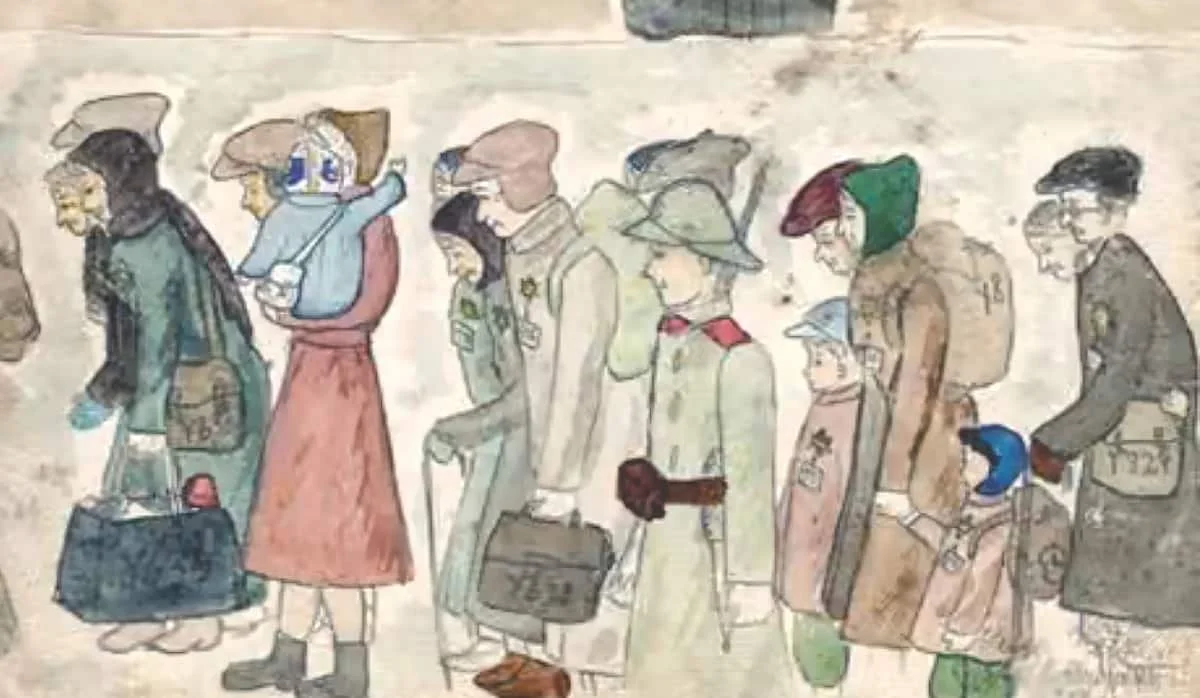
Helga Weiss was ten years old when she and her parents arrived in Terezin concentration camp in 1942. Her dad told her to “draw what she sees.” This drawing illustrates each person carrying 50 kg of allowed luggage. Photo: theguardian.com
In an online recorded interview, Helga Weiss said she began keeping a diary at the tender age of eight years. “I had a very lucky childhood, but after occupation everything changed and our life became more and more difficult,” Helga said in broken English. “My father was expelled from his job and children were expelled from school.”
The excerpt from her diary read: “Since March 15th there’s not been a single calm day. Everything is our fault, even though we didn’t do anything. We can’t help being Jews.”
On October 5, 1941, young Helga wrote in her diary that she had started wearing a yellow star. “There will be transports. Everyone is getting ready to travel. The arrests never stop. When you leave your house you never know if you will return,” she wrote.
On December 5th of that same year, Helga and her parents were transported to Terezin concentration camp. “There are 21 of us in quite a small room,” the diary read. She was one of 7,000 people in the camp.
Helga’s dad was placed in a men’s camp; however, they managed to smuggle messages to each other. “I was fond of drawing and it was December,” Helga recalled. She had packed crayons and a sketch pad and sent her dad a drawing of children building a snowman. “It was a memory of our past life. It was my first drawing in Terezin. When I smuggled it to my father he answered me and wrote, ‘Draw what you see.’”
“After his response I started to describe the everyday life in Terezin. During the time I created about 100 of these drawings because I spent almost three years in Terezin. They are very important today because it was forbidden to make pictures, to make film. And maybe that’s why my drawings today are so important because there wasn’t any other picture material.”
She remembered the Germans producing one film. “It is the only film which existed, but it is propaganda. From this film they asked the prisoners to come in front of the camera and say, ‘I am well in Terezin. I don’t miss anything,’” she recalled. She also remembered the International Red Cross Commission coming for a visit. The event was recorded in her diary.
“A huge clean is in progress. It’s funny, but it looks like they are trying to make Terezin into a spa town. Freshly planted grass is coming up in the square. The middle is decorated with a bed of roses. There’s a pool, merry-go-round, and a see-saw. Everything was arranged like a stage set,” young Helga wrote.
“At the time we very much hoped when the Red Cross would come they would see the situation and something could be changed for the better,” Helga said. “But the inspection came and they looked only at the places which were shown to them. The inspection lasted only a half day, and in the evening they described in a certificate they found everything to be okay. So it was a great propaganda and they believed it.”
In 1944, Helga and her mother were deported from Terezin and spent the remainder of the war in three different camps. Since it was impossible to write or draw anything in those camps, her drawings remained hidden behind a wall of one of the barracks in Terezin. After the war she reclaimed her drawings, and soon after her return in May 1945, Helga recorded everything that had happened since leaving Terezin and tried to draw all those experiences.
After the war, Helga and her mother returned to their old apartment in Prague. “We left the camp, but we carry the camps still inside. They told us we were free and go home, but it was no home. Nobody expected our coming back. I had my mother. I never gave a thought that we could be separated. So when I married, she lived with my family till her death,” she reported. Helga spent the remainder of her life living in the apartment in which she was born and became an accomplished artist.
Helga’s father didn’t survive life in the camps. “I always think about him. I always wondered what my father would think and say. He was very fond of music and I married a musician, and my son and granddaughter are professional musicians. I always think it would be a pleasure for him,” she said.
Her drawings accompany her diary, which was published in 1998 in the book Draw What You See, and Helga’s Diary was published in 2013.
As the generations read her diary and look at her drawings, she offers some advice. “Read it very carefully and keep it in your memory of what happened. And do something so it won’t happen anymore. That’s what we learn. To be tolerant of each other, to understand each other, not to be selfish, to be healthy, to have family, to have hope and freedom.”
Who could have guessed that a child’s drawings would someday record history?