
Book Review: Walking Upstream
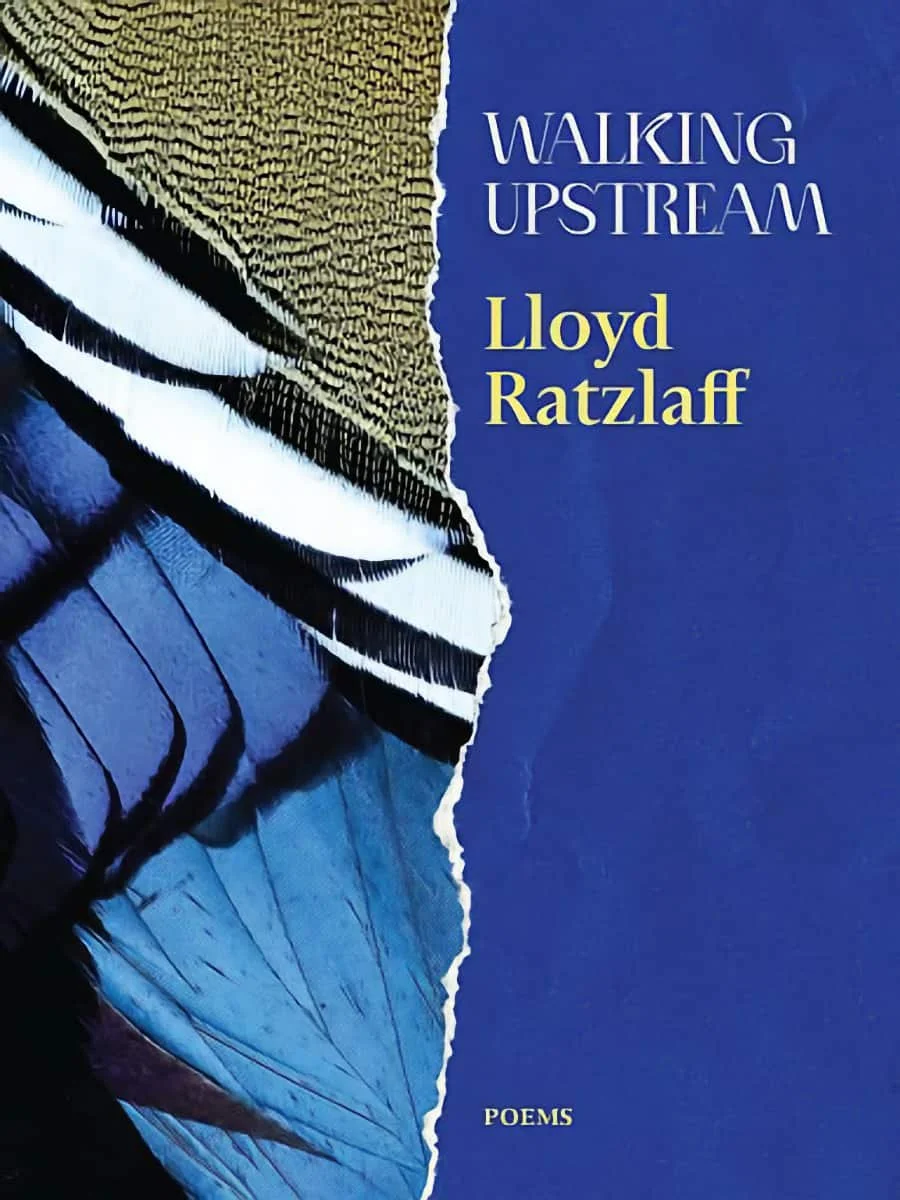
By Lloyd Ratzlaff
Published by Thistledown Press
Review by Shelley A. Leedahl
Saskatoon’s Lloyd Ratzlaff—essayist, former minister, walker in wild places—has released his first poetry collection, and wow. I know this man and have long believed that poetry lives in him; I’m grateful his mostly contemplative poems—alive with water, birds and creatures—have found a deserving home in Walking Upstream.
The first two sections map “The Old Path” and “The Irresistible Forces,” while the latter two, “To Grouse like a Mountain,” and “Afloat,” ferry readers from “Coffee at Starbucks” to a “Prairie Cemetery” and “Nirvana Big Rest Motel.” At the latter, the narrator waits out “a steady rain” and concludes “I can do nothing/for my mother in her care home bed/but think,/look Mother,/I am because of you.” Whew. For a piece with just eleven lines, this unsentimental poem packs serious emotional punch, aided by an image of the “white petunias [that] sag/under the water’s grey weight.”
Ratzlaff possesses a gift for evoking emotion in just a few poignant lines—some might consider this poetry’s raison d’être—and his poems reflect that over a lifetime, the former counsellor’s mastered the oft-ignored art of listening. “The Realm” contains just nine lines, but in the second stanza we glean humility and the quiet nature of an individual “who likes to hide sometimes/in a copse of aspens/and listen.” This keen ear’s tuned as naturally to “Red-winged and yellow-headed blackbirds” and a ”mud hen in the reeds,/so near yet so hidden,/only the tinks on some tiny anvil/betray the place of [its] nesting” as it is to windchimes: “A small orchestra improvises/a jazz suite for spring.” How lovely.
Ratzlaff’s frequently addressed his Christian fundamentalist upbringing, and several poems in this smart collection demonstrate that he’s still processing “the old religion,” with its emphasis on sin, fear and “holy hullabalujah.” As a child, a “travelling evangelist” with a “flappy bible” warned that “children without Jesus in [their] hearts/will [writhe] in a lake of fire/and brimstone.” In “My Quarrel with Yahweh,” Yahweh is “a night spirit./The sun hurts his eyes.” The poet refers to a beetle “multicoloured like Joseph’s coat,” and offers a short “prayer for the river.”
I prefer the reflective poems and the intimate concerns they sometimes reveal, but the collection never feels somber, as lighter poems—about the poet’s dogs, or adolescents’ overuse of the word “like”—braid through the book. I enjoyed the farewell poem, “Goodbye Little Apartment,” in which Ratzlaff said so long to the “last of the old fridges/that wouldn’t defrost” and the “shabby carpet,” and, more importantly, to “beloved friends” with whom he “walked to the riverbank,/got three sheets to the wind,” and “played hide-and-seek till five in the morning” before they settled “on a footbridge” and “looked into the stars.” It’s a profound example of how, if we’re fortunate, the child in each of us never leaves.
Always, there’s great reverence for avian friends. Bluejays, chickadees, “The gulls of Wanuskewin” and the mighty magpie, of which Ratzlaff writes: “our people don’t think/highly enough/of your people.” Oh, I say, indeed.
THIS BOOK IS AVAILABLE AT YOUR LOCAL BOOKSTORE OR FROM THE SASKATCHEWAN PUBLISHERS GROUP WWW.SKBOOKS.COM