
ATB Financial: From back rooms to Main Street
(Reprinted from October, 2018 of The Oyen Echo by Bernie Krewski)
Alberta Treasury Branches, adopting the brand name ATB Financial in 2002, officially celebrated its 80th anniversary on September 29.
In keeping with ATB’s modest beginnings, Oyen branch manager Kari Kuzmiski and her staff invited customers to share refreshments over several days to mark this momentous event. Eightieth-year celebrations in the month of September also coincided with the 46th anniversary of the Treasury Branch serving the people of this district.

ATB staff: November 3, 2025. From left, Karrie Drouin, Client Service Representative; Daina Wilson, Everyday Banking Advisor; Samantha Kuhn, Branch Manager; Jenna Bingeman, Personal Banking Advisor; Hina Vasani, Client Service Representative. Samantha holding the ATB 50th Anniversary History Book that will be on the coffee table for people to view. Photo by Diana Walker

Happy 80th ATB September 28, 2018: Celebrating ATB’s 80th birthday with customers were staff Carissa Schuetzle, Chandra Shantz and Kari Kuzmiski. Missing from photo: Tammy Hermanson-Foster and Pam Stark.
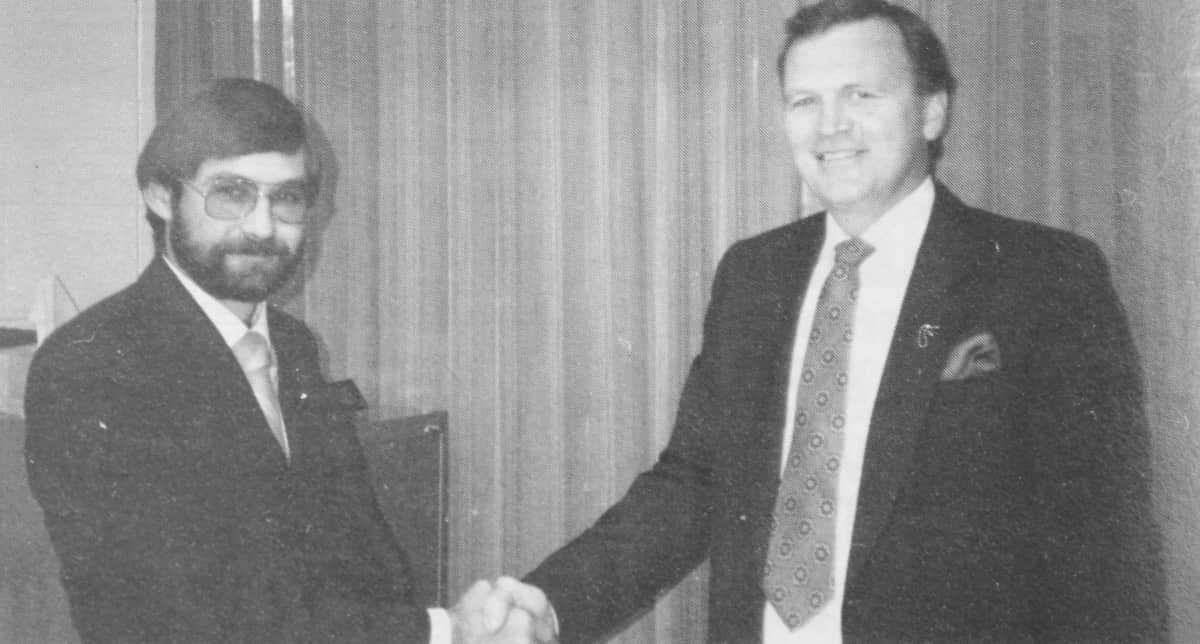
TB Manager Lyle Grewer (L) with Mayor Doug Lehman.
ATB’s presence in Oyen began unpretentiously in a trailer at its current site on September 18, 1972. That lot (and several adjoining) had been occupied by the Beaver Lumber Company since 1921 but vacated around 1968. Quite by chance, Beaver Lumber was similarly a grass-roots prairie company, established in the small community of Wolseley, Sask., in 1883. Later, as a prominent local business outlet in this area, it was an important supplier and highly instrumental in the early development of Oyen and many of the surrounding communities.
The first ATB manager was J.F. Anderson who had a staff of five employees. Treasury Branch officials at that time viewed Oyen as having much potential, seeing it as a growing and resourceful community. They noted numerous local major achievements: the installation of a high school dormitory, head office for the Acadia School Division, a new high school, nurses’ residence, Legion Hall, medical/dental clinic, and 25 extended care beds.
The Treasury Branch moved into the newly constructed Provincial Building on May 9, 1975. During the next decade, its staff increased to 10, serving an area population of about 3,000 people. Despite very dry conditions in the mid-1980s, Manager Lyle L. Grewer in 1987 reported a ten percent growth rate in the number of loans issued.
So, what’s significant about this – the anniversary of a longstanding business enterprise and service in a prairie town? A brief glance and the ATB Financial story in Oyen could easily end here. That, however, would disregard and ignore the unparalleled and unprecedented role that ATB has played in the history of this province.
Oldtimers know some of that story from experience: no rain, no markets and no money. But the far-reaching story has received little attention in Oyen’s history books and in the holdings at the Crossroads Museum & Archives. The following will hopefully serve as a brief update.
The seeds of ATB were inconspicuously planted on August 22, 1935, within the context of several wide-ranging events. The United Farmers of Alberta (UFA), a former agrarian protest movement, had governed Alberta for 14 years. None of its MLA’s were re-elected – all failed to gain a seat in the provincial election held on this date!
In a record turnout of voters, 80%, the Social Credit League won 56 of the 63 seats in the Legislature. This new group of MLAs was not then an actual political party and had no official leader during the election campaign, other than William Aberhart, the League’s guiding force. But thousands of Albertans were his faithful followers, listening to his radio broadcasts from the Prophetic Bible Institute in Calgary. Political offerings and solutions grounded in “Social Credit” theory often accompanied his religious and inspirational talks.
Aberhart, a prominent high school teacher and preacher, had little interest in government and political matters for most of his life. Rather, his abilities were those of an evangelist and entertainer. Not having campaigned in the election but urged to become Premier by elected members, he eventually won a seat in a by-election on November 4th, 74 days after the provincial election. This unusual process resulted in this headline in a Boston newspaper: “Alberta Goes Crazy!”
The Depression had devastated Alberta’s farm-based economy as export markets collapsed. The Alberta Treasury was literally penniless. Farmers, facing the same burden, borrowed heavily and took on too much debt. The Province, like Saskatchewan, was only 30 years old (compared to Manitoba’s 65 years and BC’s 64) and had not yet developed a financial infrastructure to sustain such a young and undeveloped economy. Elected officials, seeking alternative remedies to address the prevailing poverty of Albertans, were unable to find many options and avenues to pursue.
Attending summer school for teachers at the University of Alberta in 1932, as one of my professors told us, Aberhart discovered Social Credit and became interested in monetary reform. This subject was being discussed in England and throughout the British Empire, but no government jurisdiction had experimented with putting Social Credit theories into practice.
Premier Aberhart latched on to this central idea: if government could oversee the issuance of credit, rather than the private sector, then it could also provide consumer discounts to balance consumption with full production. No one wins, in other words, if a company or business produces a product and no one can afford to buy it. Aberhart repeatedly said he simply wanted to make the market system work more efficiently.
Various schemes were proposed by Aberhart’s government. The objections and roadblocks were immediate and frequent. In a four-year period from 1937 to 1941, 11 laws passed by the Alberta Legislature were disallowed, either by the federal government or by the courts. They were deemed to be beyond the jurisdiction of any province.
A major hurdle was the Canada Bank Act of 1871. It stated that only federal chartered banks can offer specific financial services to the public. The anger in Alberta toward the federal government in Ottawa was intense, undoubtedly fueled by the presence of thousands of American migrants in Alberta. Federal law in the United States, by contrast, specifically prohibited the establishment of national chains of banks. There, banks were small, confined to local communities and able to back developments in their own district. They were also highly vulnerable to bankruptcy – perhaps of little concern when Alberta’s own financial situation was similarly precarious.
This provincial/federal jurisdictional dilemma occurred then and, unfortunately, repeatedly arises, even to this day. Constant laments from Alberta “about those $@#x*s in Ottawa” have regrettably become part of our political fabric. Canadians would demonstrate more political maturity and wisdom if they enhanced their understanding of their own country’s history, and minimized comparisons with the United States. The American constitution and political structure are very different than Canada’s. Governance and the rule of law south of the border often seems to be perceived as some form of evil!
Canada’s constitutional framework establishing this country as a self-governing federation was set out in the British North America Act of 1867. That document framed the Canada Bank Act which became William Aberhart’s stone wall.
Canada in fact was not very “self-governing” until much later. For example, Canada was not fully independent from Britain, including having control over its natural resources, until the Statute of Westminster in 1931. More personally, I was born as a “British subject,” not a citizen of Canada, until that legislation was passed in 1948.
Aberhart would have done better if, instead, he had aimed his arrows at Great Britain. Anyone who reads Ken McGoogan’s fine book, “How the Scots Invented Canada,” will understand what I mean!
Fortunately, Aberhart and his cabinet found a loophole in federal regulations. Treasury, Alberta’s finance ministry, could lawfully open branches in locations where the government wanted to provide banking services. Every person or business interested in utilizing this government-based banking service could simply sign a service contract. Consequently, the government would be engaging with individuals and businesses, not “the public” as required in the Bank Act. In short, Albertans were being invited to join a “credit club” or “credit house.”
Here’s what the “Chinook Advance” (a newspaper in the former village 40 km west of Oyen) published on September 29, 1938: “Credit Houses Open on Friday – Six ‘credit houses’ or branches of the provincial treasury will be opened in Alberta Friday, Hon. E.C. Manning, Provincial Secretary, stated Sunday at the Prophetic Bible Institute. The points selected are Edmonton, Grand Prairie, Rocky Mountain House, Andrew, St. Paul, and Killam.”
Manning’s announcement followed an Order-in-Council (a Cabinet order) issued on August 29. Formal approval by the Legislature, passage of the Treasury Branches Act, did not occur until November 22, 1938. Nonetheless, ATB was on its way!
Office space was secured wherever it could be found. The level of service would vary – either a full-service ATB branch, a sub-branch, or a simple Treasury Branch agent or agency might be available. Coronation, for example, immediately opened a branch in 1938, whereas the Provost service began as an agency operated by W.H. Murat.
Among the 22 service outlets opened in 1939 were Consort, Drumheller, Hanna, Stettler and Castor (an agency housed in a lumberyard). In 1946, Brooks opened a branch in a converted theatre.
By 1941, ATB’s revenues from deposits were enough to begin granting loans. Growth was more rapid after the War. There were 45 branches, 6 sub-branches, 110 agencies, and 331 employees by 1950.
Underlying and amplifying the ATB story is this truism: small businesses are the economic anchor of this province and this country. Such enterprises constitute about 98% of all employer businesses in Canada. Nearly 50% of Canada’s workforce is employed in small businesses, and 40% have fewer than 20 employees.
With such risks, why would anyone want to establish a small business? David Campbell, a successful Canadian businessman who died recently, put it this way.
Nothing can be more thrilling than conceiving an idea, assembling the resources, piloting a risky venture, and reaping the rewards. Then being able to say: “I did that!”
For its 50th anniversary in 1988, ATB published a book entitled “Treasured Memories: A Celebration of Alberta Treasury Branches.” Oyen is featured on p. 226, accompanied by three advertisements: The Town of Oyen; Archie and Gayle Emblau Alberta Hotel and Motel; and Gordon Johnsen, Oyen Pharmacy. Their small contributions were of great help to me in writing this story.
Overcoming seemingly insurmountable barriers is the fundamental story of ATB and many small businesses. Commitment and persistence are often the key.
A reminder of that occurred years ago in the ATB office at Stettler, which also issued motor vehicle licenses. The very diligent clerk kept telling the applicant that she could not issue a license because he had no insurance. Overhearing the discussion, the manager quietly took her aside and explained that RCMP officers operating police vehicles don’t need proof of insurance!